A journey without derailments
by Ernie Tee
Ernie Tee is Professor Film History & Film Analysis at the Dutch Fim Academy
Article in Dutch Movie Magazine Skrien, 1991
How broad the term ‘video’; can (or should?) be stretched, has been proven at the ninth edition of the World Wide Video Festival in The Hague. In video art, film and television are no longer excluded, as well as the use of documentary and narrative in the medium which is no longer unimaginable. Hence, in The Hague they had selected two video works as highlights of the festival: ‘Nord Express’ by Rob Rombout (who will get a roulement in Belgium) and Private Hungary by the Hungarian Peter Forgács. These are two video works that both have time as subject, the time of travel and the time of the familylife. ‘Nord Express’ will be discussed on the following pages.
In a variety of ways, the film viewer is like a traveller: his trip is one that has a start and an endpoint, where in between the route is planned by the story that is showed. Sometimes the story doesn’t seem to be going fast enough: it slightly slows down in its journey. At other times the developments follow each other at a rapid pace and the journey progresses well. There is always a degree of awareness of its final destination, but both this and the route towards the end is uncertain: the film is highly unpredictable, and its appeal largely derives from this uncertainty about the course of events.
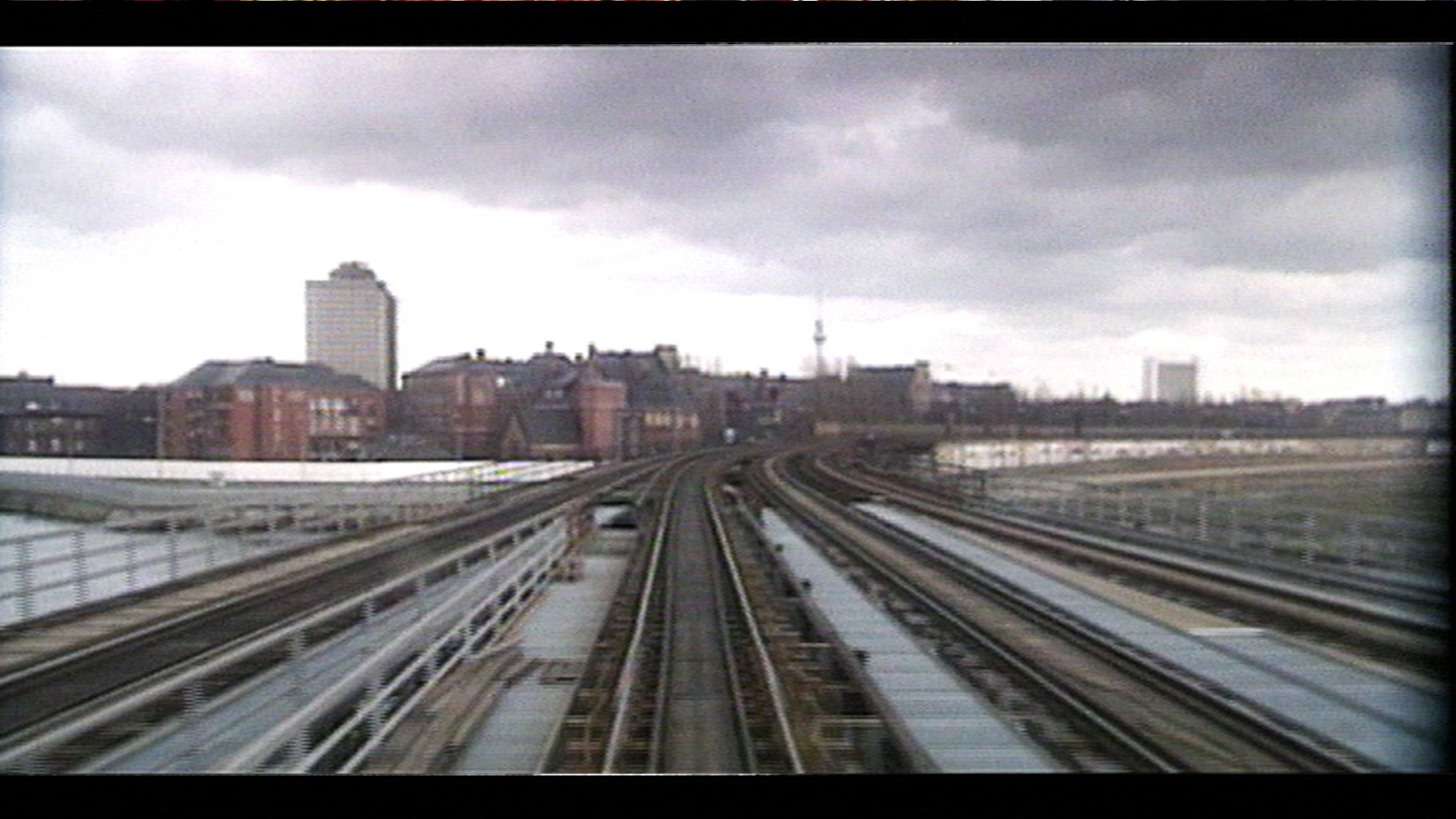
‘Nord Express’, a videofilm by Rob Rombout, a Dutch video artist working in Belgium, follows the route of the Paris-Moscow express train. The film opens with footage of Gare du Nord and ends, nearly an hour later, with the arrival at the Moscow central station. In the meantime about two days pass, the duration of the trip. However, ‘Nord Express’ isn’t the sort of film where the excitement is caused by the capriciousness of the trip, by an uncertain destination. There are no adventurous wanderings for the viewer in this film. On the contrary, the start- and endpoint are fixed in advance, and no cues are given to assume that the railway traveller will not make it, or the express train will never reach its destination. The journey laid before the viewer is not presented as a trip full of unpredicted events, but rather as a well-arranged trip by the way of the Russian capital as its endpoint.
Scattering
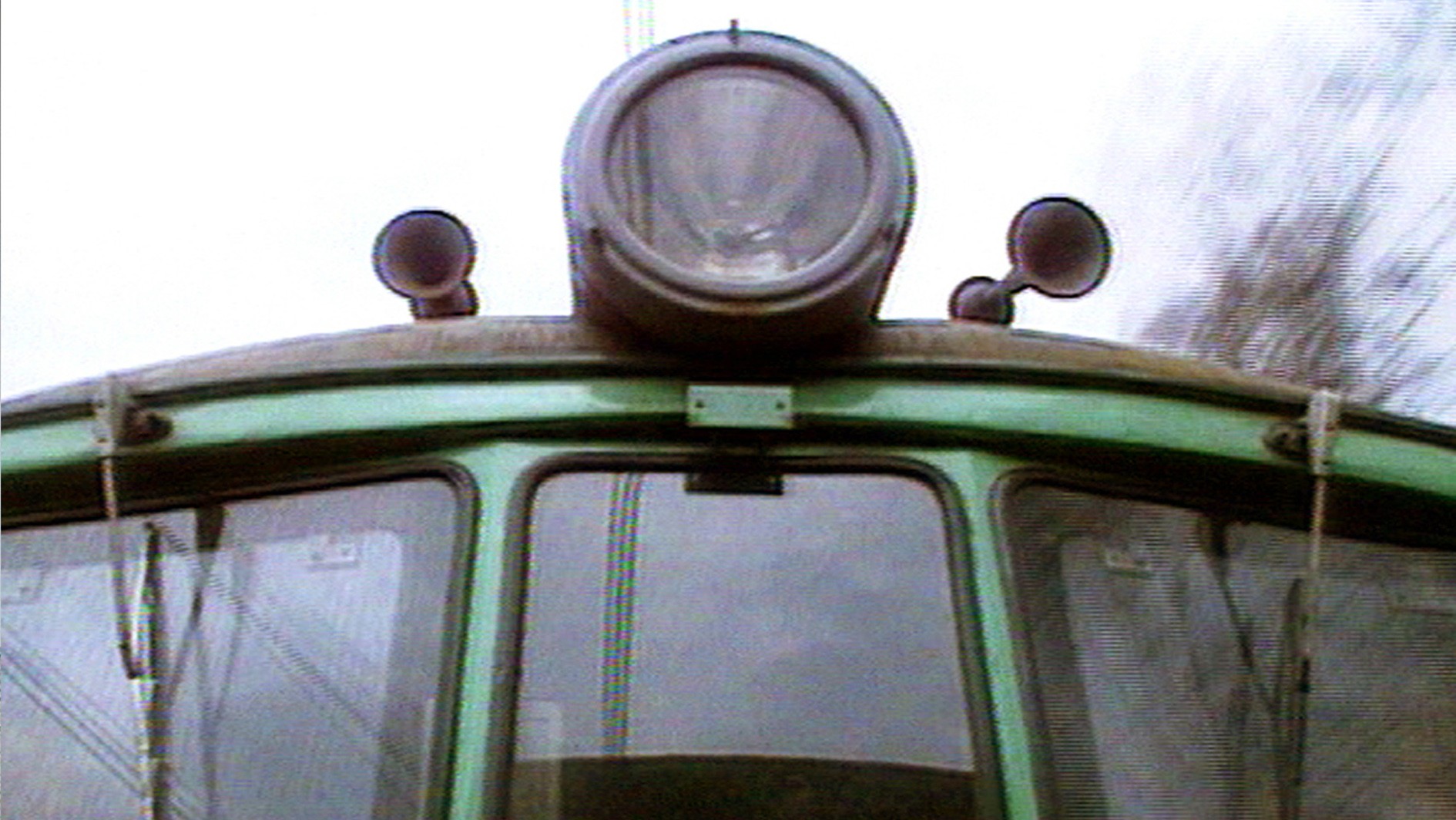
However, ‘Nord Express’ does bring about a special experience due to the fact that Rombout hasn’t made the trip, but travelling itself the subject of his film. ‘Nord Express’ breathes the atmosphere of a long train journey, where the travel spectator, for the time being, should try to entertain himself. During such a long trip everything you encounter is scattering: conversations with random fellow travellers, with train officials, the passing landscape, stations, cities, and so on. No derailments, no mysterious disappearances, no strange characters imposing upon you, in short, no excesses: everything is quite normal in the Nord Express from Paris to Moscow, and at the same time all those ordinary events on such a journey are by all means entertaining.
Through an untroubled view on what might happen before your eyes, you will certainly not be bored as a traveller on a long train journey like this. Rombout’s camera does indeed carry the view of someone who does not withdraw himself into the boredom of a long journey, but carries the view of curiosity at the chatter of the people around him, to a railroad house along the route, to a passing wall painting, to what the train stewardess has to say. Moreover, the view is certainly not one of disinterest: it is not a wandering gaze, first here, then there. That would be the perspective of someone wondering how on earth to kill the boredom. No, the view in ‘Nord Express’ is almost a study: almost every frame is in movement, locking the images of the passengers, the engineer, the railway employee, the platform, and of the outside surroundings. But in its perfect seriousness the camera captures the most light-hearted topics: the painterphilosopher, who made a wall painting at one of the stations, his house which is right next to the railway, the Polish fisherman who makes a short train ride across the border almost every day to cast his fishing rod in a lake nearby, the train stewardess who is seated next to a vase with faded tulips telling about her wish to fill her life with arranging flowers, Nemsjinovska, the Russian gatekeeper, who clears the rails from snow with a broom, a medical student from Cameroon; all of them everyday people with everyday stories that can make a long train journey so enjoyable.
« From time to time black and white images from the past are shown. But this historical digression doesn’t form didactic images concerning the railway; they are as equally short as incomplete, they are accidental, as loose thoughts that come to mind when passing the stations and cities through which the express train is heading off to the East. »
Equally light-hearted is the ‘historical perspective’ that accompanies the Nord Express. From time to time black and white images from the past are shown: the first railway works, the opening of the central station in Warsaw, railway workers in the Russian border town of Brest who swap the bases of the trains. But this historical digression doesn’t form didactic images concerning the railway; they are as equally short as incomplete, they are accidental, as loose thoughts that come to mind when passing the stations and cities through which the express train is heading off to the East. For example, when the train arrives in Berlin (the old, divided Berlin), we only see a historical picture of the construction of the Wall, then a present-day image of its destruction, and finally two youngsters who are selling small stone leftovers of the East Berlin Wall. And whilst the train enters Warsaw, we see images of a party from the 1950s that took place at platform three: Platform three was the place where Polish filmmakers at the time celebrated their Happy new year. The small outings to the past are like stretching the legs during long journeys. They are the images, impressions, from an accidental traveller, incidentally, not those of a documentary maker.
Visible time
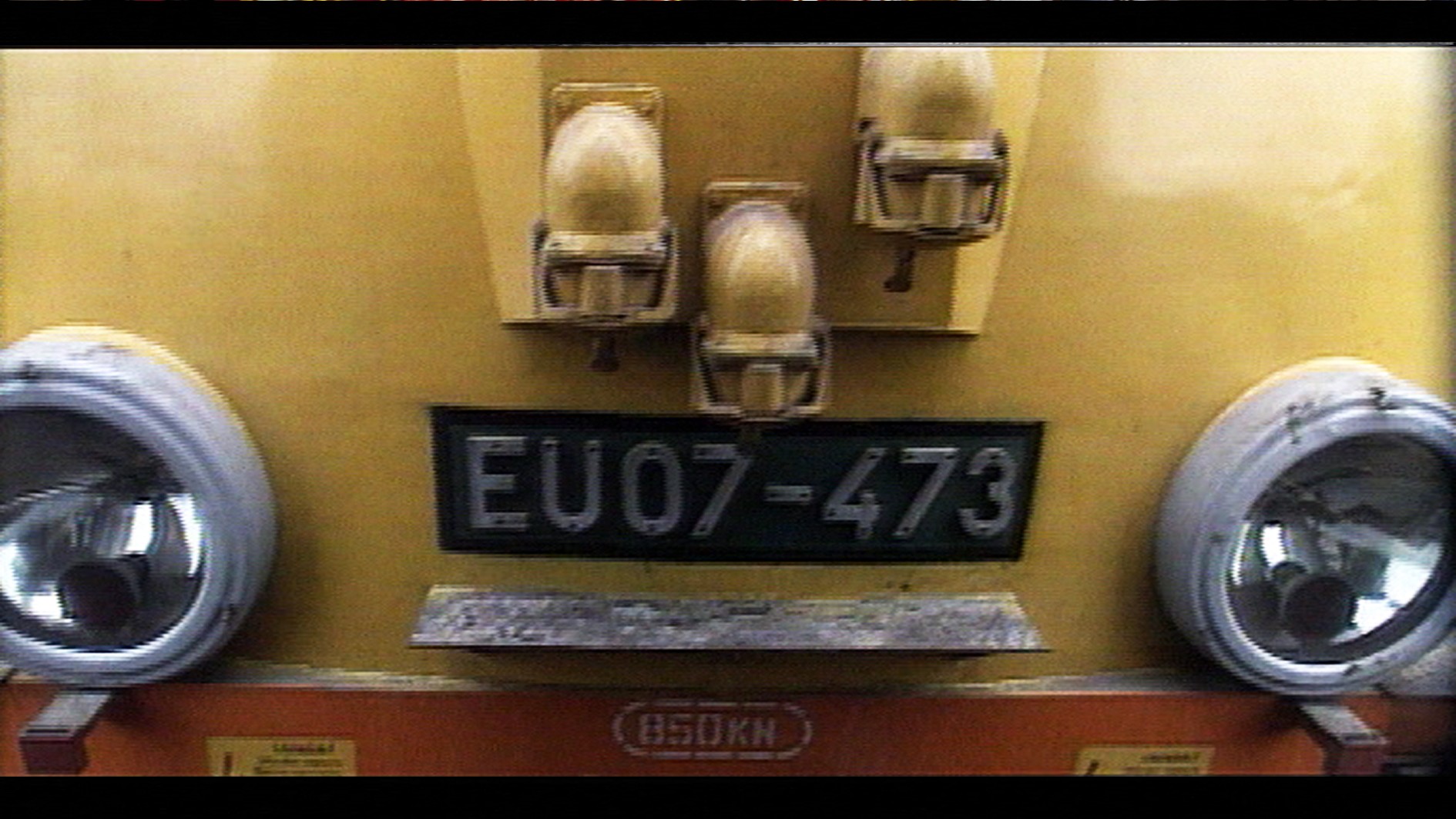
Time passes by, but for a traveller never unnoticed (unless he is in a deep sleep). The course of time during a trip is always set in a fixed framework, namely the framework determined by the time of departure and arrival. At what time that is exactly, is irrelevant. More important is the question of how far we already are, how long the trip is yet to be, how far we are removed from our destination. At each stop the exact time is checked, by which the film helps us by showing the exact station and time in the subtitles. The course of time is therefore not obfuscated, but, as required by a traveller, continuously registered, made visible. This visualization of the passing of time also happens in other ways. By using flashy video techniques the evening suddenly ‘falls’ as the train leaves a station: the afternoon blends into a ‘nuit américaine’; No hard cut, and also no elliptical time jump: although the darkness may have entered (i.e. we went from the afternoon into the evening), the time-spatial continuity of the moving train is intact. The same train, the same houses in the background are still in the frame, except now the living rooms lights are on. A similar effect is used a little later in the film when a train window frame is used and the same smoothing takes place. A surprising technique, by which the course of time is abstracted by the time- space in the displayed scene, an abstraction that also belongs to the experience of traveller (who indeed isn’t wondering; ‘what time?’ but ‘how long still?’). This technique is not like the elliptical editing, an indication for the passage of time itself.
‘Nord Express’ is the journey of the express train Paris-Moscow itself. When in the last frame the nightly facade of the central station of Moscow is shown, the viewer realizes that the journey has come to an end. The feeling of having made a satisfactory, long journey dominates, during which, thank goodness, nothing strange, nothing grave happened. But this assurance was already given to the viewer earlier in the film, in the conversation with a group of tourists from Armenia, that had reported to him: ‘Tout est bien, tout est normal‘.