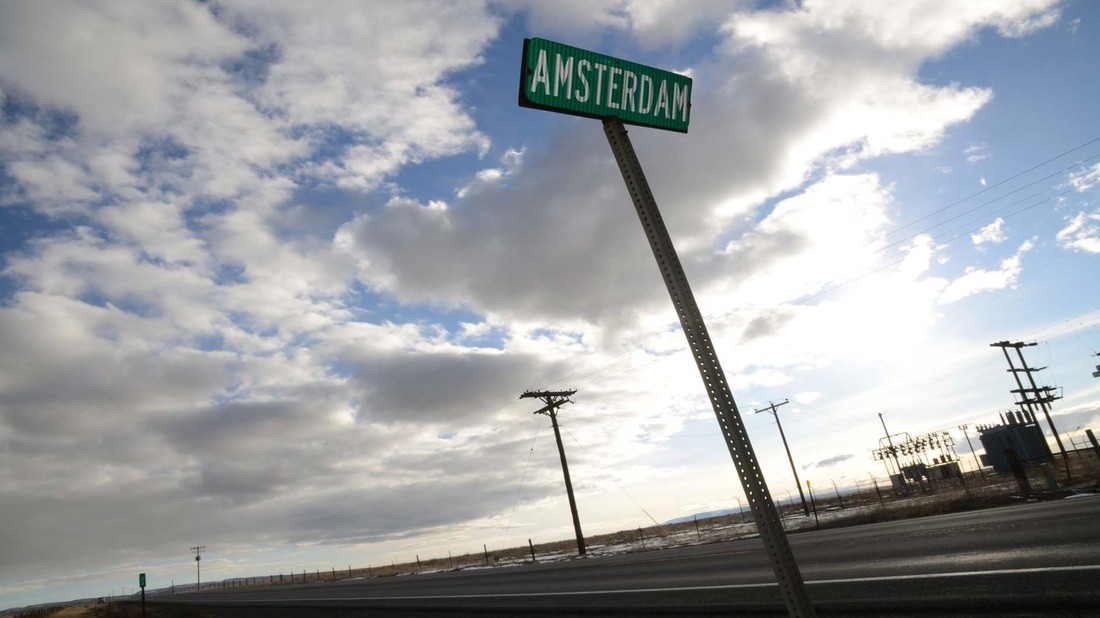
Amsterdam Stories
by Eduarda Neves, 2017
In Amsterdam via Amsterdam (2004) and Amsterdam Stories USA (2012), two films by Rob Rombout and Rogier Van Eck, to question becomes the hermeneutical tool that does not set out to deny meaning or succumb to it, but to make history be told in a different way.
We are not before a random inventory of American history, at which we would arrive through the narrative of history or narrated history. We hear voices that give us back the reality of the conditions of existence. In their essentially analytical dimensions and apparent simplicity, there is no place, in these images, for pure forms: it is about listening to those who have their own voice rather than to those who speak on their behalf, as we are told in Amsterdam Stories USA.
Overcoming the potentially normalising logic of the “window into the world”, of the referent and the simulacrum, artworks, as social systems of meaning, confront us with structured and structuring spaces through which we gradually organise and project meaning:
The presence of the real does not mean to assert realism but to defend a poetics that finds in reality the truth of appearance or, in a Nietzschean manner, there is no truth other than appearance.
The “filmic text” is shaped as a space of complex intertextuality and becomes a place of dialogue: everyday life, social relations, urban violence, death, poverty, racism, multiculturalism, segregation, loneliness, freedom, happiness, ideals, ways of life, colonization, war. Texts that overlap in layers, through which we hear that, although America projects itself as a land of big cities, “most Americans are insular (…) they do not know what happens outside their borders”, although we can also speak of “a decent, generous, tolerant people”.
« In the wandering of these travellers who renounce certainty, is expressed what we are in becoming, our becoming-other, what we gradually become, but also what still separates us from ourselves. »
Likewise, in these Amsterdam Stories, if on the one hand there is no room for exceptional circumstances, on the other a certain geography of memory reminds us that, when we think we are already close to another place, to another time, we might have, after all, never left. In the wandering of these travellers who renounce certainty, is expressed what we are in becoming, our becoming-other, what we gradually become, but also what still separates us from ourselves.
As Michel Foucault noted, the ship is the heterotopia par excellence:
In the boats of Amsterdam Stories, dreams do not dry up and continue to plough across the sea.
A for Amsterdam. A for America. Actuality has announced itself. There are no happy stories.